Game development for multiplayer, mobile and the web
We build games that stay fair and smooth on ordinary phones and shaky connections, from the rules engine and bots to the match server and the in-game shop.
Game development, for us, is not just art and animation; the hard work is the part players never see. In a multiplayer game no client should know an opponent's cards, a dropped connection should not ruin the match, and bots must play well enough to keep offline players engaged. We build online, mobile and web games on an architecture that solves these problems from day one.
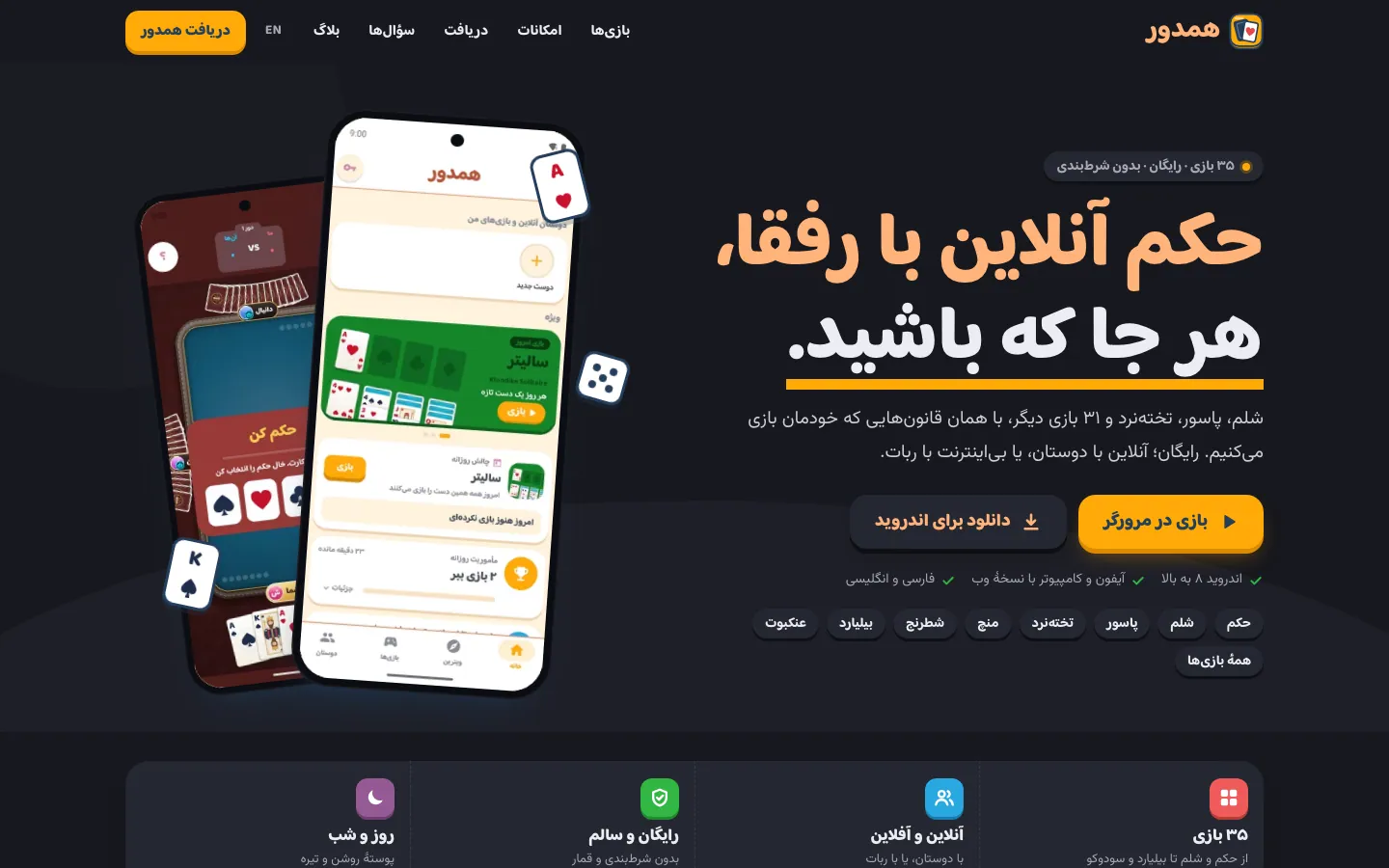
Hamdor, our own social games platform, has 36 games in 5 categories. We wrote one Kotlin Multiplatform rules engine that runs on the phone for offline bot play and on the server as the authoritative referee for online matches. The server runs Ktor over a single WebSocket with ProtoBuf messages, ranking uses Elo, and payments come through ZarinPal, the Bale wallet, Cafe Bazaar and Myket. The web version is the same code compiled to Kotlin/Wasm, shipped at 2.7 MB brotli.
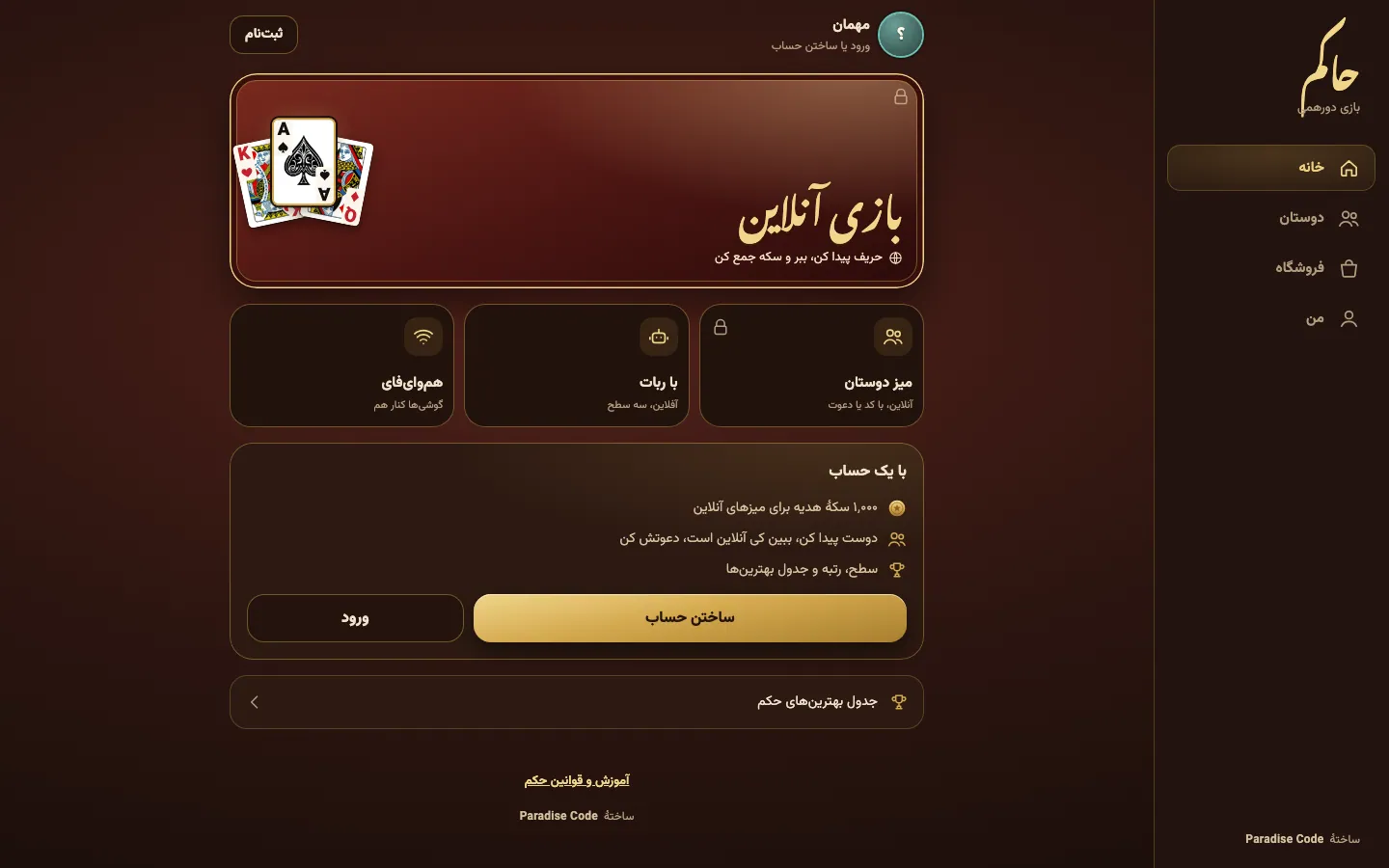
For Hokm and Shelem we built two classic Persian card games on one shared engine: online play on an authoritative server, LAN play over WebRTC, and offline play against bots, the hardest of which uses PIMC search. If you have an idea for a card, board or competitive game, we can take it from rules design through launch and server operations.
What we build
Multiplayer game development
An authoritative server that runs the game logic and defeats cheating, with private rooms, quick match, reconnection and resume.
Mobile game development
Android games in Kotlin and Jetpack Compose, tuned for mid-range phones, with offline play and app store publishing.
Web games and WebGL
Games that run in the browser with no install, built with Kotlin/Wasm, three.js or WebGL, and installable as PWAs on iPhone and desktop.
Online card game development
Hokm, Shelem, Pasur or your own rules, with every hand fully hidden from other clients and a rules engine covered by automated tests.
Game bots
Bots at several difficulty levels, from simple heuristics to PIMC search, for offline play, empty seats and replacing dropped players.
Ranking, shop and admin
Elo ratings, leaderboards, friends and chat, an item shop and subscriptions with local payments, and a live console to run matches.
How we work
- 01
Rules and core loop
We write the rules down precisely, local variations included, define the core loop and revenue model, and build a playable prototype fast.
- 02
A shared rules engine
Game logic is written once, independent of the UI, and covered by automated tests, so bots, clients and server enforce exactly the same rules.
- 03
Network, server and bots
We build the protocol, the authoritative server, matchmaking and reconnection, tune bots at several levels and test on weak connections.
- 04
Launch and live ops
We ship on Android and the web, deploy servers with Docker, backups and automatic rollback, and keep the game live through an admin console.
Related work
What drives the cost?
Game development cost depends less on art than on rules complexity, the online layer and post-launch operations. Once rules and scope are written down, we give a phased estimate.
- Game type: single-player offline, online multiplayer, or both on one shared engine
- Rules complexity and the number of games or game modes
- How smart the bots need to be, from simple heuristics to advanced search
- Platforms: Android, web, PWA, and how much custom art and animation is needed
- Social and revenue features: ranking, friends, chat, shop, subscriptions and admin tools
Frequently asked questions
How much does online game development cost?
It depends on the kind of game. A single-player offline game with simple rules is far less work than an online multiplayer game that needs an authoritative server, matchmaking, reconnection, ranking and a shop. Bot intelligence, the number of platforms and the amount of custom art matter too. We write the rules and scope down first, then estimate phase by phase, so you can start with a small but complete version and add social and revenue features later.
What are the challenges of online card game development?
Fairness comes first: no client may see anyone else's cards, so game logic must run on the server and each seat receives only its own hand. Then come the local rule variations players know by heart, where any mistake destroys trust. You also need to handle disconnects mid-hand and replace departed players with bots without stalling the table. In Hokm, Shelem and Hamdor we solved all of this with an authoritative server and a shared rules engine.
Should I build a mobile game or a web game?
An Android app gives smoother play, notifications, reliable offline mode and a place in app stores. A web game opens from a link with no install, runs on iPhone and desktop, and is excellent for sharing and early user acquisition. You do not have to choose: in Hamdor the same Kotlin code builds the Android app and compiles to Kotlin/Wasm for the browser, at 2.7 MB after brotli compression.
How does game server development for multiplayer work?
In multiplayer game development the authoritative server is the referee: the client only requests a move, the server checks it against the rules, updates the state and sends each player only what they are allowed to see. It is the only serious defense against cheating. We build servers with Ktor over a persistent WebSocket with compact ProtoBuf messages, make reconnecting and resuming the default, and keep state in PostgreSQL.
How smart can a game bot be?
As smart as the game and budget allow. For easy levels, rule-based bots are enough and play naturally. For card games with hidden information, methods like PIMC sample many possible opponent hands and pick the move with the best average outcome; our hard Hokm and Shelem bot works this way. The key is that bots and server share one rules engine, so a bot can never make an illegal move.
Does your game development studio support the game after launch?
Yes, and for an online game this matters as much as the build. We deploy servers with Docker, a backup before every release and automatic rollback on failure, monitor errors and load, and give your team a live admin console with match, shop and revenue reports. Seasonal events, new games and balance tuning can continue under a maintenance agreement. The source code and infrastructure always belong to you.
Further reading
WASM use cases for product teams
Where it pays off. A practical guide with a real scenario and execution checklist for WASM use cases for product teams.
Mobile web vs PWA vs native in 2026
Product decision criteria. A practical guide with a real scenario and execution checklist for Mobile web vs PWA vs native in 2026.
Modular monolith before microservices
Cost of wrong cuts. A practical guide with a real scenario and execution checklist for Modular monolith before microservices.